
Today’s post is one about the dangers of making assumptions in science…..
For background, I built a UV transmission microscope a couple of years ago. This was done for a couple of reasons; to see if I could, to use some quirky and unusual technology and equipment, and to be able to image different sunscreen components in a formulation at both long and short UV wavelengths. A UV transmission microscope capable of working down to 300nm and below is a challenge as normal glass will just absorb the light at those wavelengths. As such it becomes necessary to manipulate the light with materials such as quartz and calcium fluoride and/or mirrors, rather than using glass.
Over time since then I have built up quite a collection of UV capable lenses such as Zeiss Ultrafluars, and Leitz UV objectives. I have a couple of condensers which I can use such as a Zeiss Quartz one. However what I don’t have is a darkground condenser which I can use in the deep UV. There have been a few made over the years, including a lovely Watson quartz cassegrain which I was fortunate enough to borrow for a while (more on that in a minute). In an old Leitz Darkground Condenser brochure they mentioned that their condensers could be requested in UV crown glass or quartz (for extra cost), but until recently I had only ever seen one Leitz darkground condenser with a ‘Q’ on it, and that was just a photo. These are rare beasts. A few weeks ago, much to my surprise, a Leitz darkground condenser with ‘Quarz’ engraved on it came up for sale on ebay, so I quickly bought it.
My assumption with this was that being quartz it would be able to transmit the light down to 300nm and below, and I could use it for deep UV darkground imaging. As we shall see, things don’t always work out as planned……
First though, some pictures of the condenser.
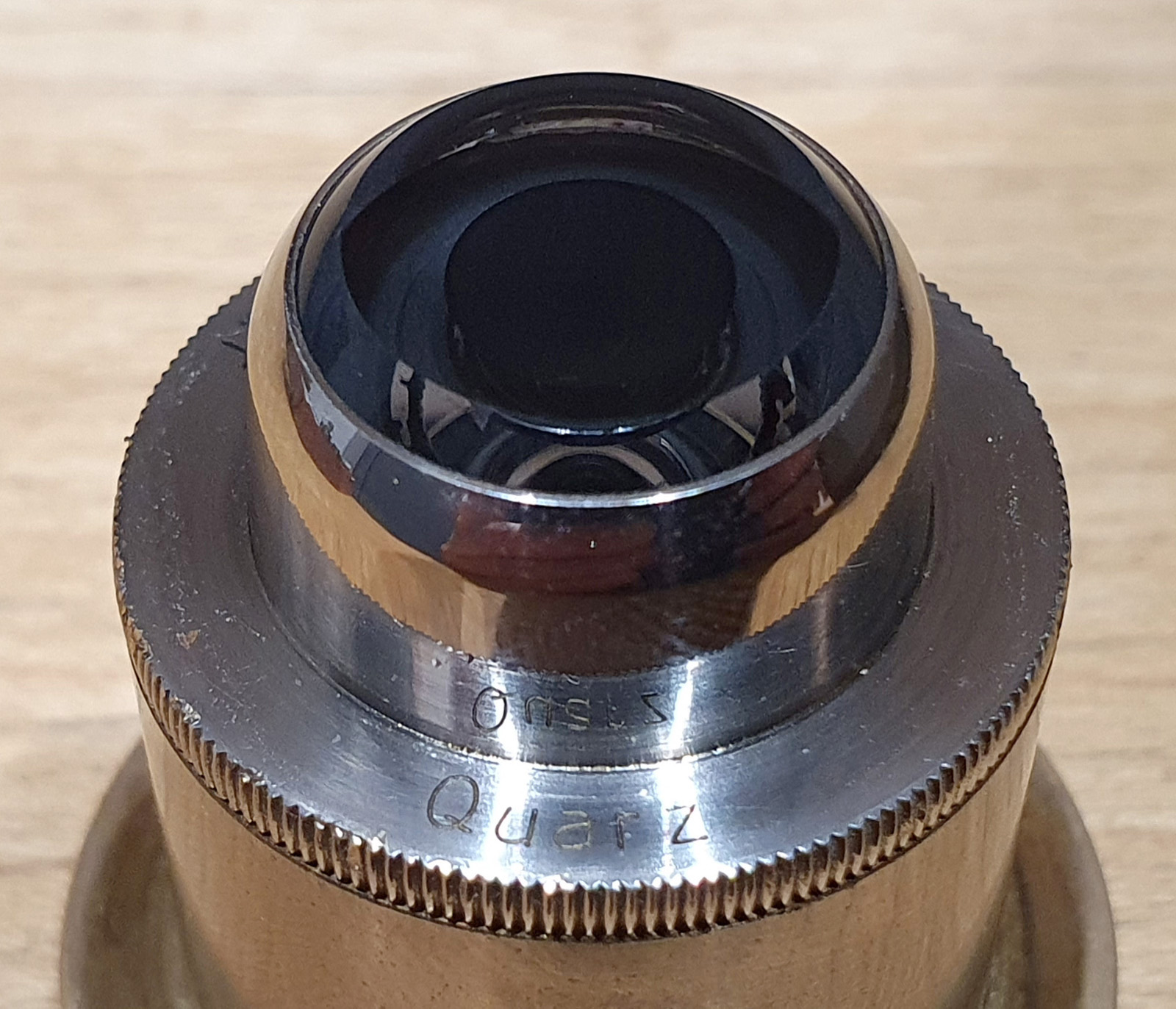
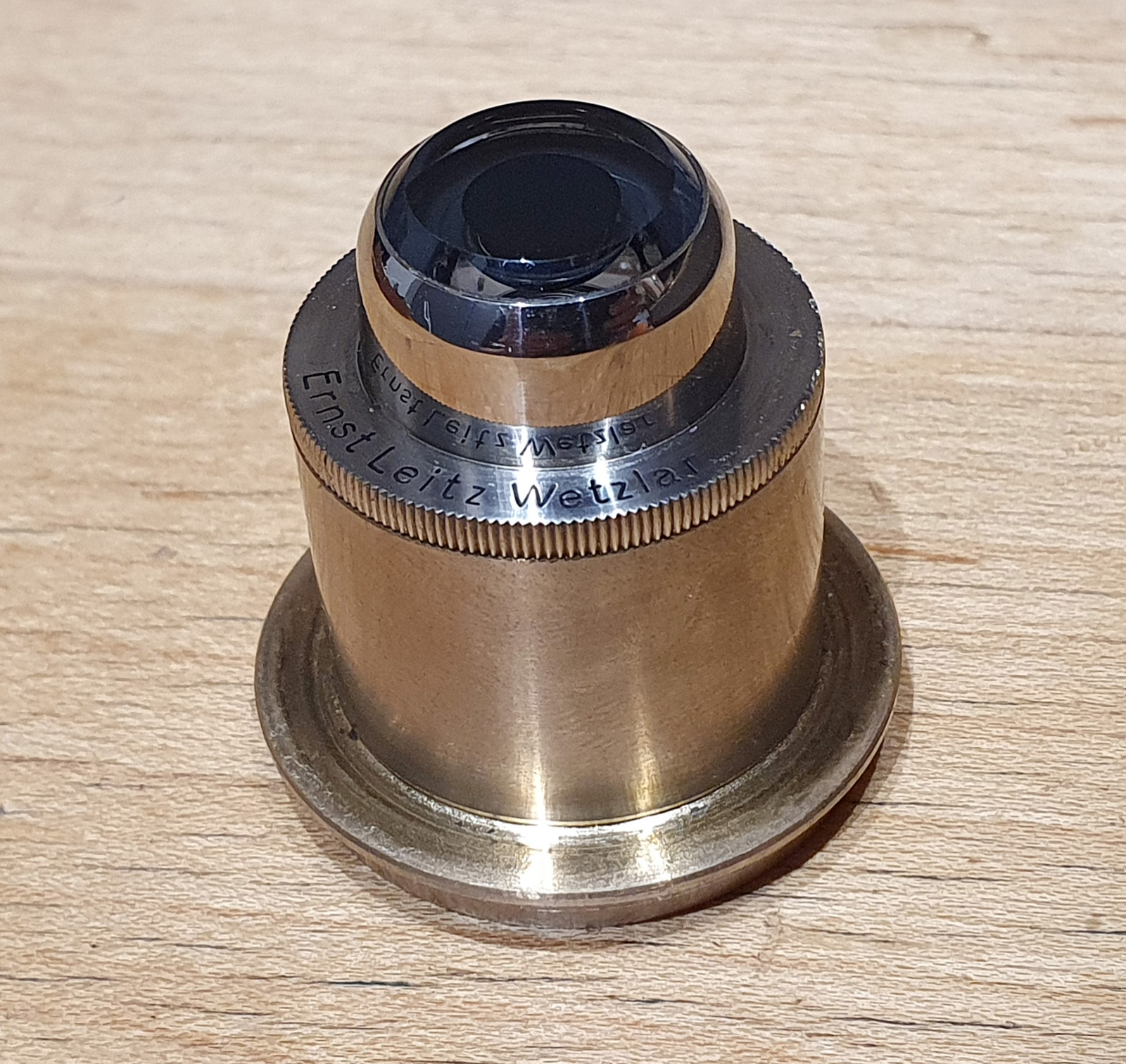
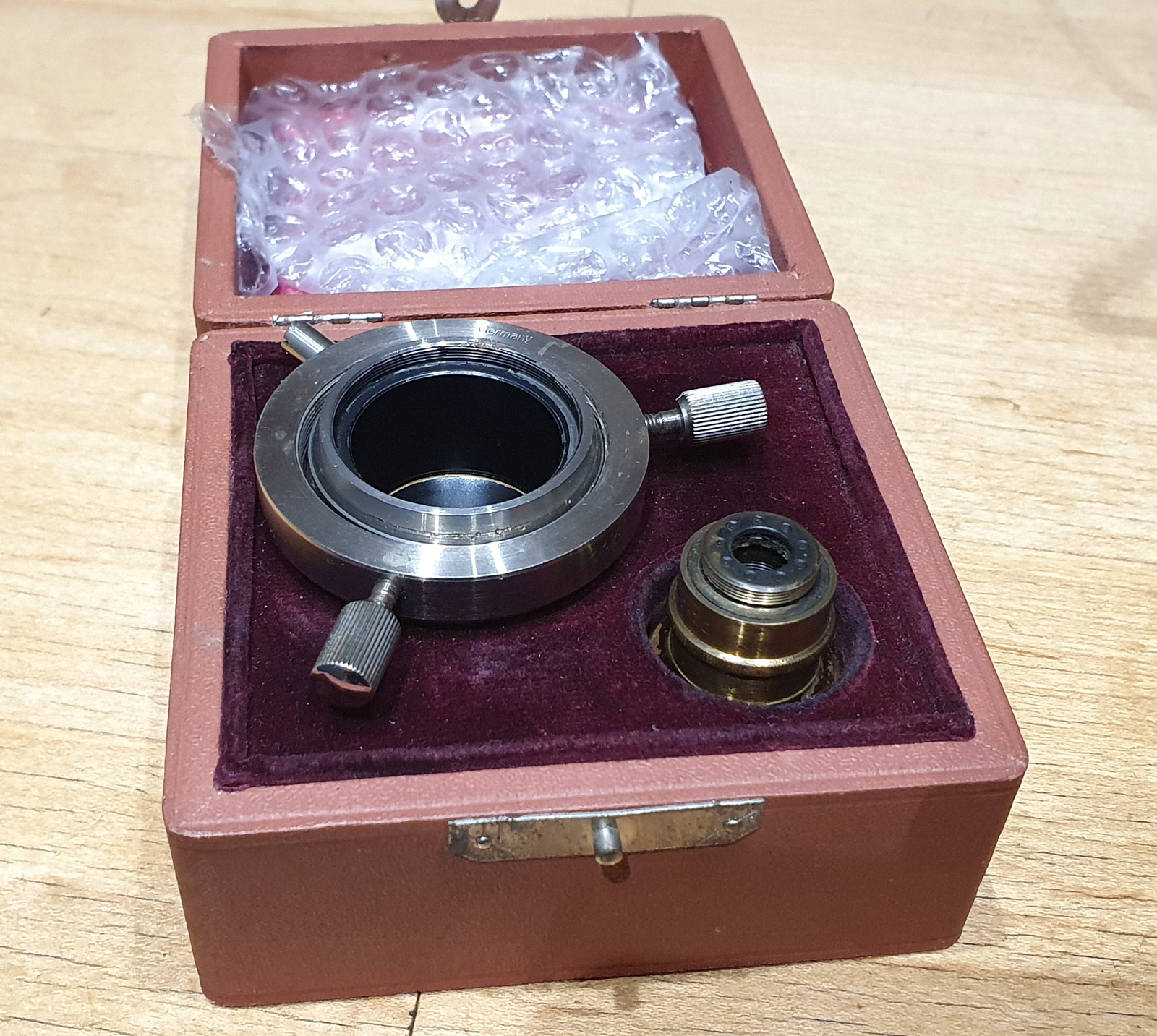
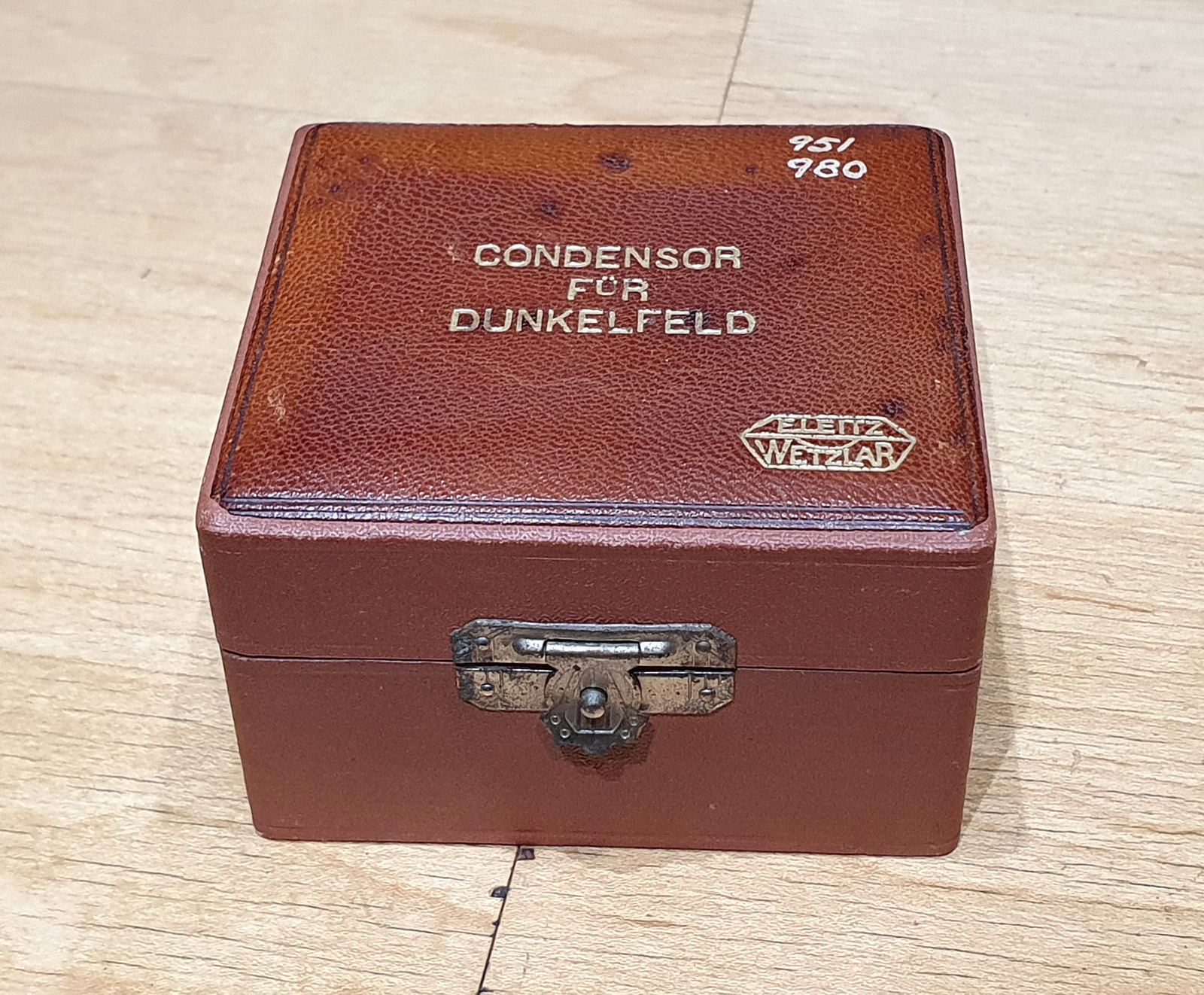
All in all, it is in pretty good condition (given it is probably around 100 years old). There are a couple of very minor scratches on the front face, but they are not near the middle, and shouldn’t really impact its usability. As can be seen in the top image, it has ‘Quarz’ (the German spelling of Quartz) engraved on it.
First thing was to try and measure the transmission through it. While I have got a device to measure transmission through lenses down to about 300nm, with darkground condensers this is a bit of a challenge, as absolute transmission is very low. Down at 300nm, with low transmission, and low sensitivity from the spectrometer at that wavelength, this was going to be a challenge. However I gave it a shot, and got the following.
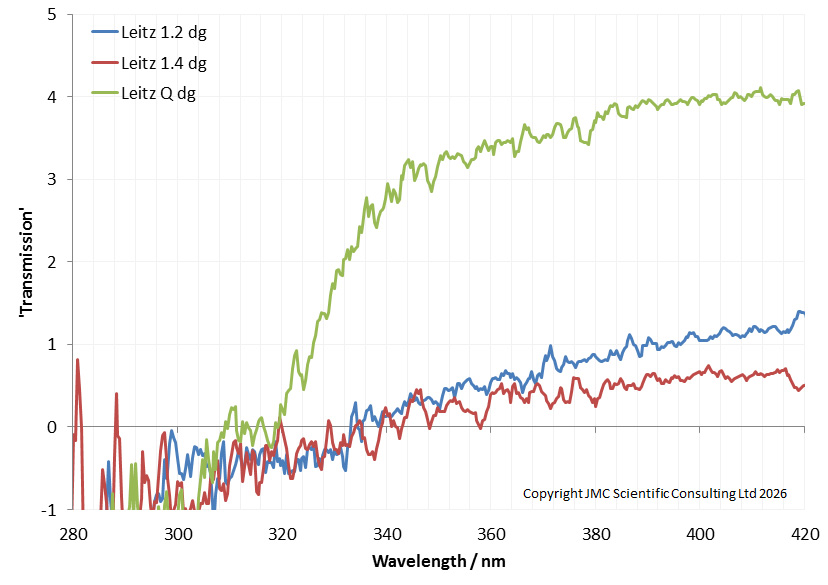
This ‘thing’ which I have labelled as Transmission vs Wavelength shows 3 Leitz darkground condensers. Two (the 1.2 and 1.4) are standard glass ones, and the Q one is the quartz one. It’s a terrible graph as transmission drops down below zero at the shorter wavelengths, which makes no sense. I am putting this down to low sensitivity of the spectrometer, and low light levels basically making it ‘noise’, as well as perhaps not optimal setup for the experiment. However there does look to be something going on with the data. The quartz condenser shows relatively good transmission down to about 340nm, but after that it drops really quickly, down to the same ‘noisy’ level as the glass ones about 320nm. This is strange as the quartz should be showing good transmission down below 300nm and even 250nm.
This got me wondering, is the Quarz condenser really just quartz? Is it a ‘fake’? One simple test, is to shine a short wavelength UV torch on to it, and look for fluorescence. A glass one will fluoresce and a quartz one should not. For this I used a 273.7nm torch I have as it has good blocking of out of band light from the filter on the front of it. Here are 3 images showing what the Leitz darkground condensers look like when illuminated with the 273.7nm torch.
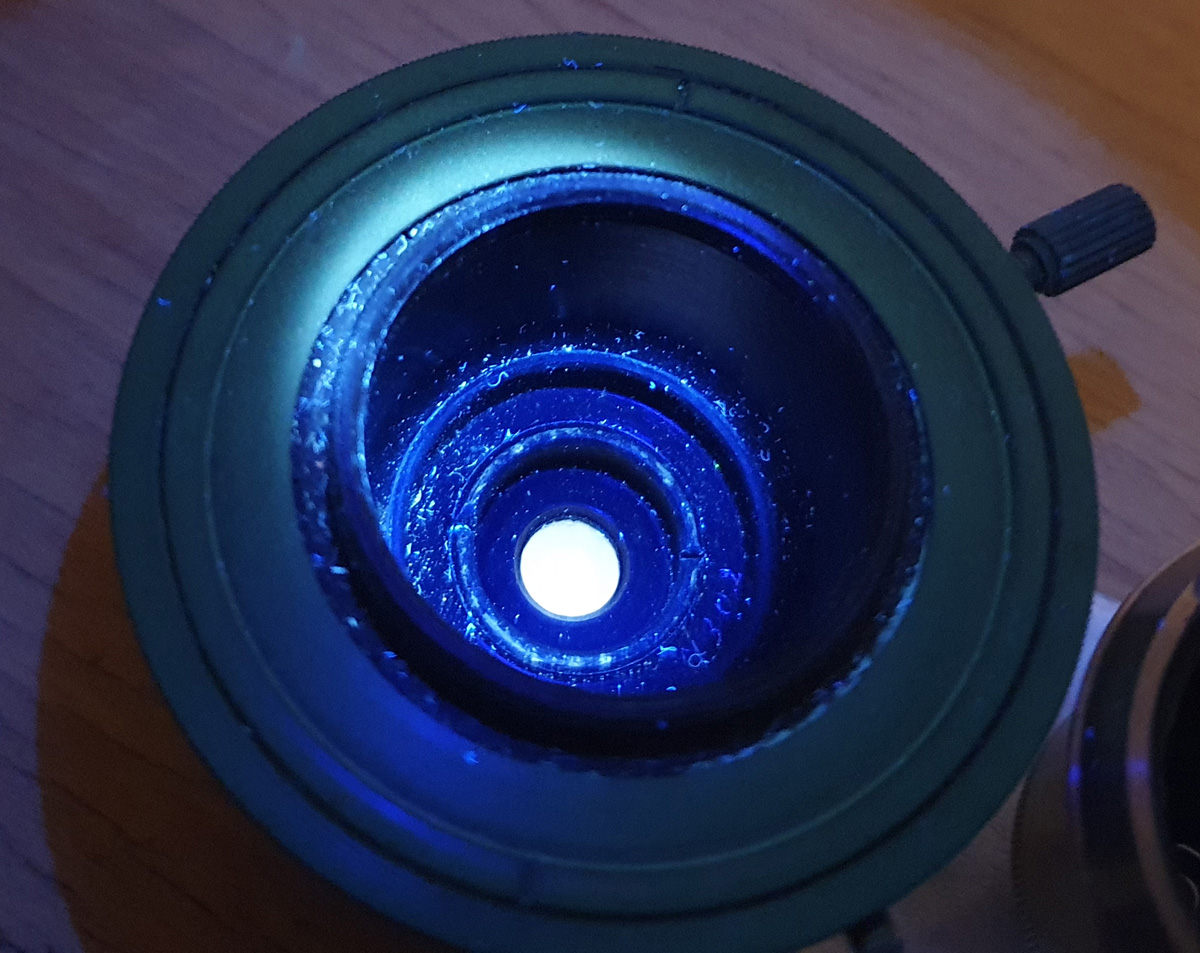
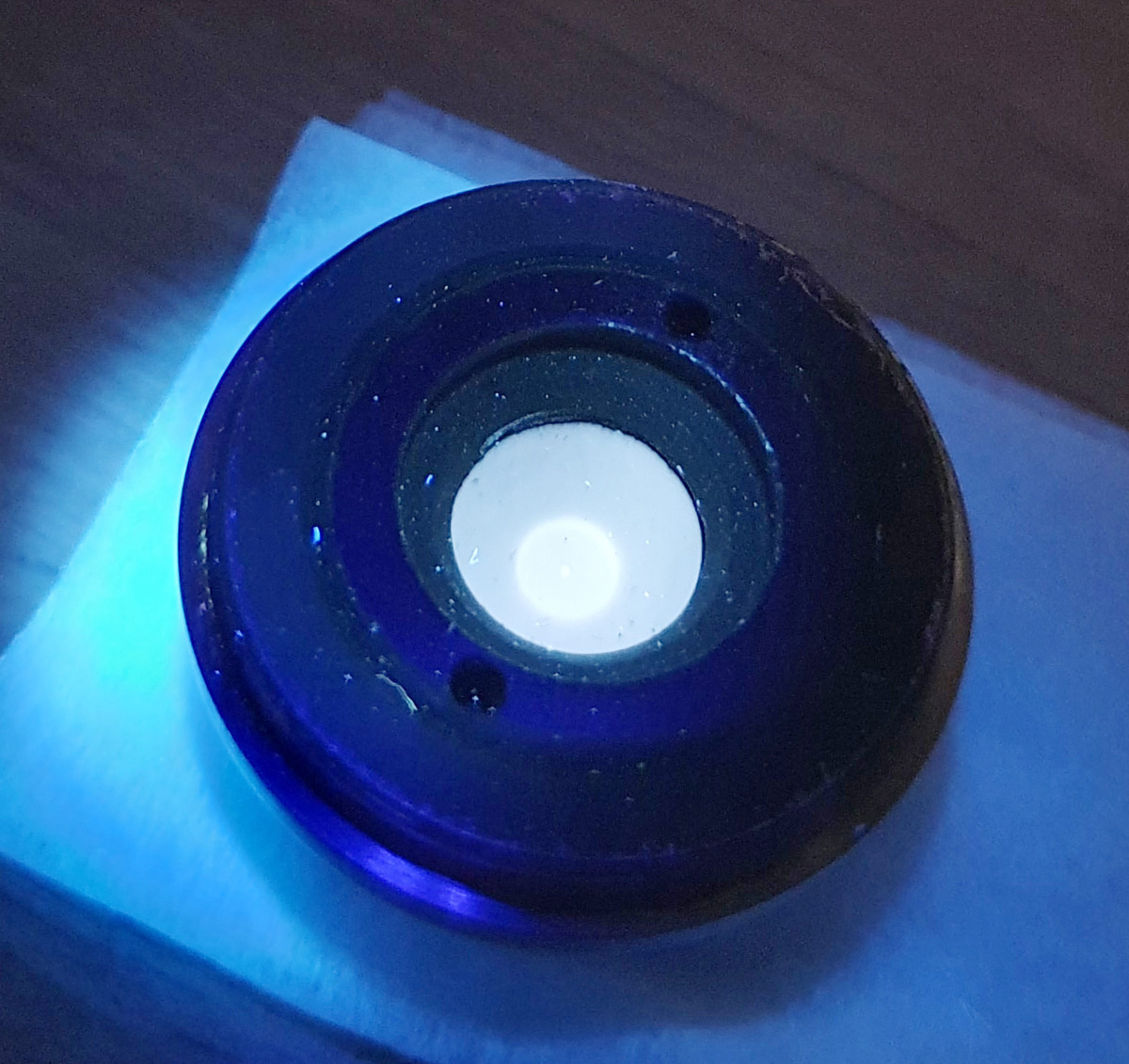
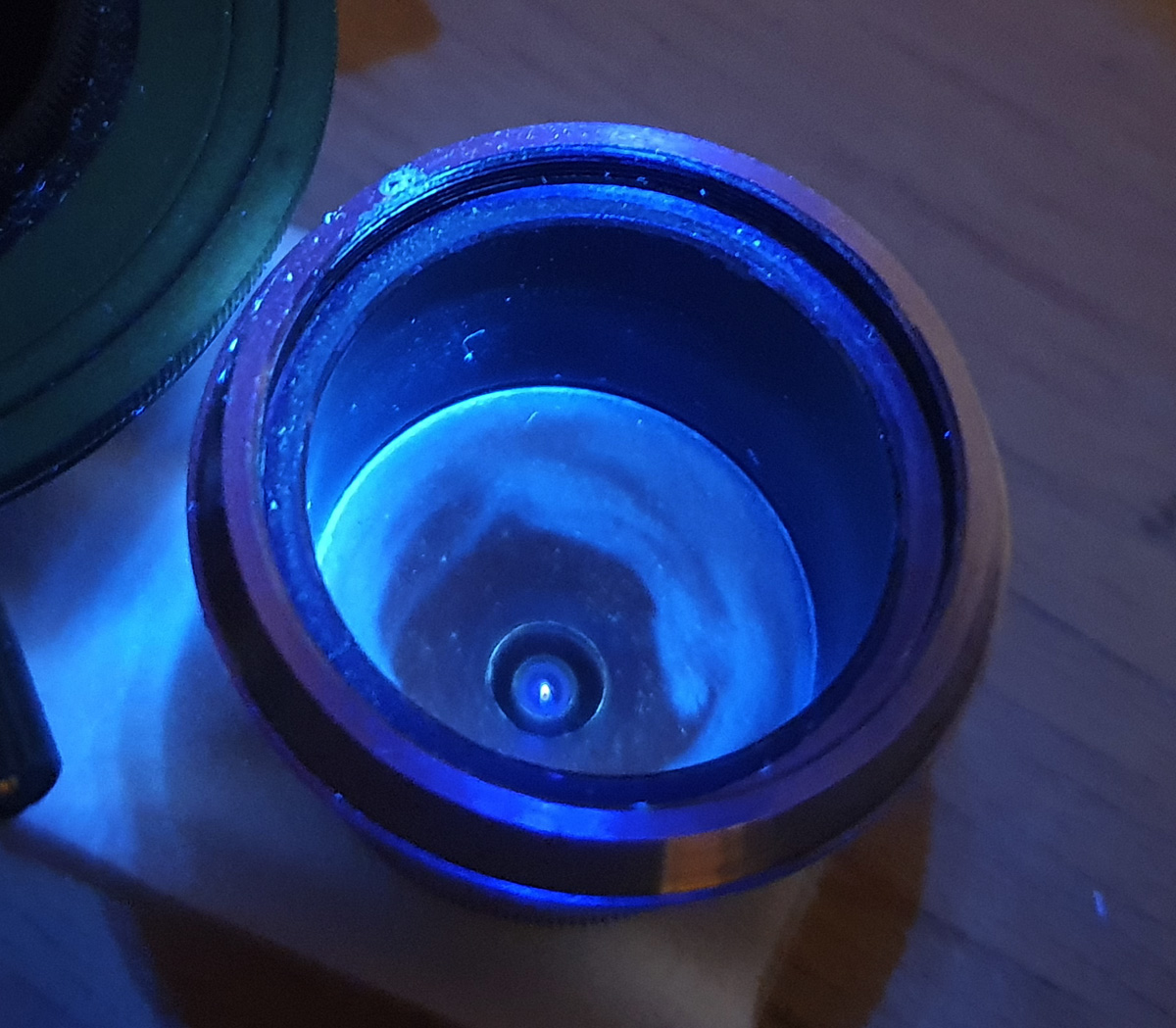
The NA 1.2 and 1.4 condensers (the first 2 images) which are made from glass fluoresce quite strongly under UV illumination. The glass in them has a foggy ‘glow’ to it. However the quartz one did not fluoresce (there is no glow from the quartz in the image under UV illumination). Phew, at least the ‘Quarz’ condenser looked to actually be Quartz.
This did not explain the unexpected transmission behavior though. Why did transmission look to drop below about 340-330nm?
This was where I started thinking about the mirror. The metal silver has some unusual properties in the UV, in that reflection from its surface drops quite abruptly in the 330-340nm region. It is a well known phenomenon, and I’ve demonstrated it before with some UV photographs of silver foil in the UV region (see here). How were mirrors typically made in the past – silvering….. So the mirrored surface in the darkground condenser is likely silver. Doh. This explains why the measured transmission through the quartz darkground condenser looked to drop below about 340nm. It’s not an issue with the quartz, but with the silver of the mirrors present which are not reflecting the deeper UV light very well. This is a bit of a blow as I had hoped to use this condenser for some deeper UV darkground imaging, but that looks to now not be possible. One lives and learns, especially when it comes to making assumptions in science…..
There was however still the interesting observation from the transmission work where it looked like the Leitz Quartz darkground condenser was letting more light through than the glass ones in the upper UV region. This would be expected – quartz will not block the UV, however glass will to some extent. There is quite a thickness of glass in a darkground condenser, so I would expect this to add up quickly.
To have a better look at behavior of the condensers in the mid-upper UV, I looked at the transmission again, but using a 365nm torch, and placing it directly behind the condenser. I am calling this the ‘throughput’ of light at 365nm.
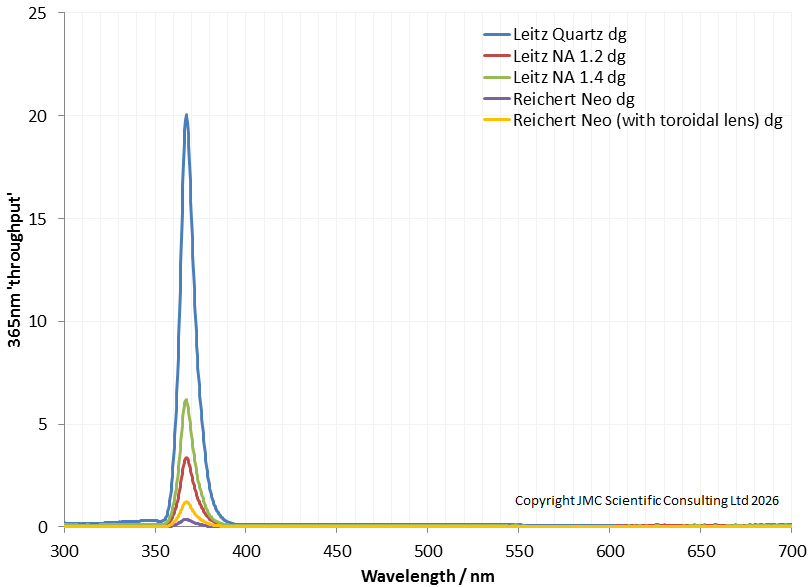
There are some quirks with the data above – not all the condensers where the same diameter at the rear (and all were smaller than the torch diameter). However the Leitz ones were all similar, so they should be reasonably comparable. The Leitz Quartz one does let through a lot more UV at 365nm than the NA 1.2 and 1.4 ones. This is significantly more, and would make the Quartz condenser great for 365nm UV work. In this test I also included a couple of Reichert Neo darkground condensers as I had read somewhere that these were good for 365nm work. One was a bare condenser, and the other has a toroidal lens on the rear which takes the incoming light and focuses it into a ring to make the darkground condenser more efficient. These two Reichert condensers are shown below, normal one on the left, and the one with the toroidal lens on the right.
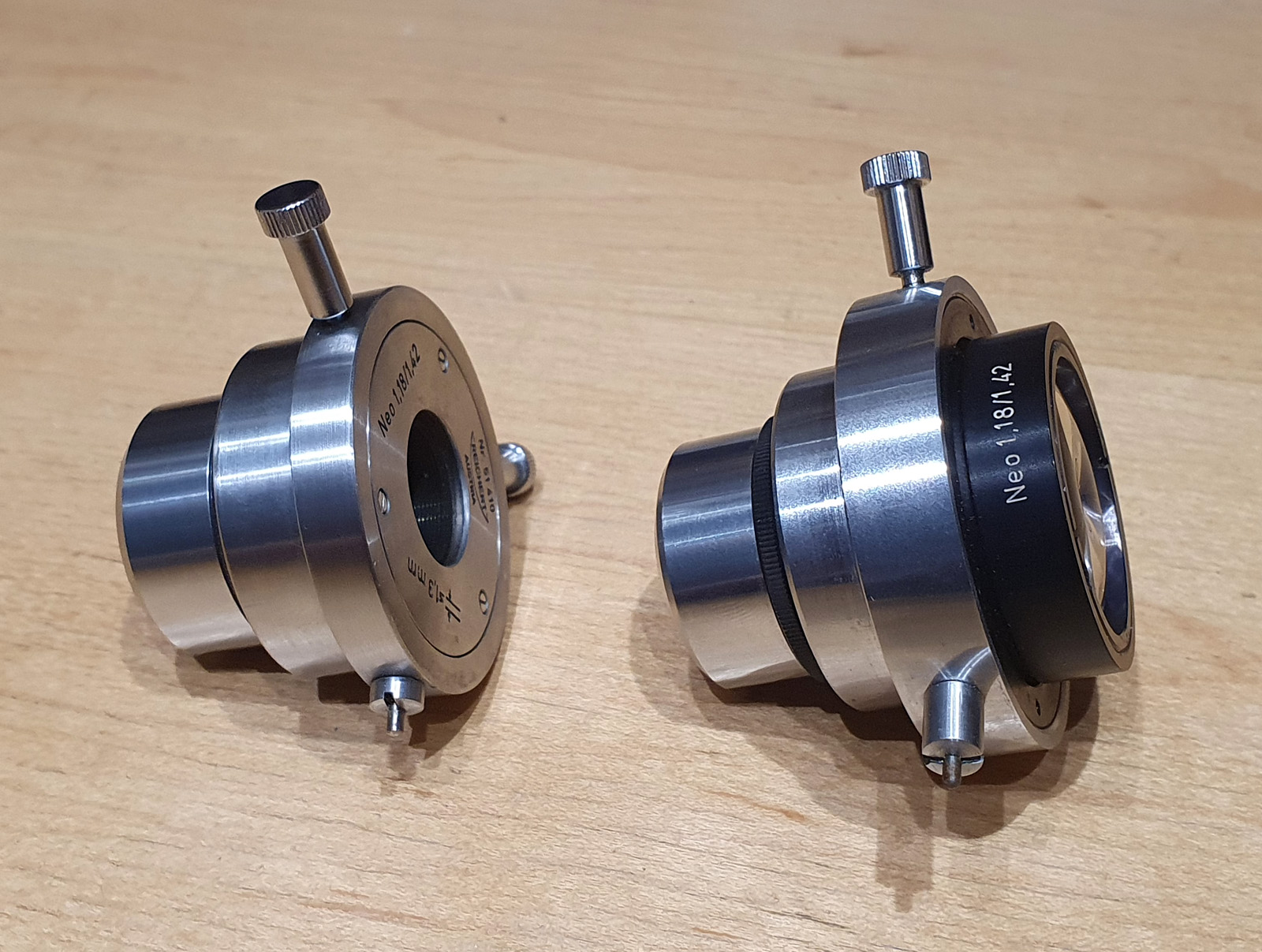
However I was surprised to find that the Reicherts let relatively little UV at 365nm through. The toroidal lens did improve this quite substantially, but there was still less light than the Leitz glass ones. So I guess I wont be using the Reichert much for 365nm work in the future then.
This was a bit of a roller coaster of a piece of work. I had assumed that because quartz based condensers work in the deep UV, that a quartz darkground condenser would also be good for the deep UV. However it looks like this is not the case, and it is not the quartz but the silver used to make the mirrors which is the issue. Am I disappointed? Yes, a bit, both in myself for making assumptions, and the results. However the Leitz Quartz darkground condenser does look to be potentially very good for 365nm work, so I will have an adapter made up to use it on my microscope. I also found out about the Reichert condenser, so will do some further checks with that on the microscope and see what is going on there.
Near the beginning of this page I mentioned about a Watson Quartz cassegrain dark ground condenser that I had borrowed in the past (some info on that here, and I wrote an article on it for the Journal of Quekett Microscopical Club). However with that lens I never tested it below 365nm, so I do not know if it would behave the same way as the Leitz Quartz one here. If it has silver based mirrors I suspect it would, but that would need testing in the future.
Thanks for reading, and if you’d like to know more about my work I can be reached here.