
What feels like a long time ago, all the way back in 2020, when I first started my microscope journey, I made myself a condenser using UV fused silica instead of glass. This was so I could use it for ultraviolet microscopy (you can see the early post here). I always wondered how well it worked compared to, for example, the standard commercial Olympus Abbe condenser. Recently I found a way of visualizing the light cone produced by a condenser, and that is by using a uranium glass cube which fluoresces when exposed to UV. Today I want to share the results of a quick test with you, looking at how these condensers behave.
First, and image made with the standard Olympus Abbe condenser, with its iris fully open.
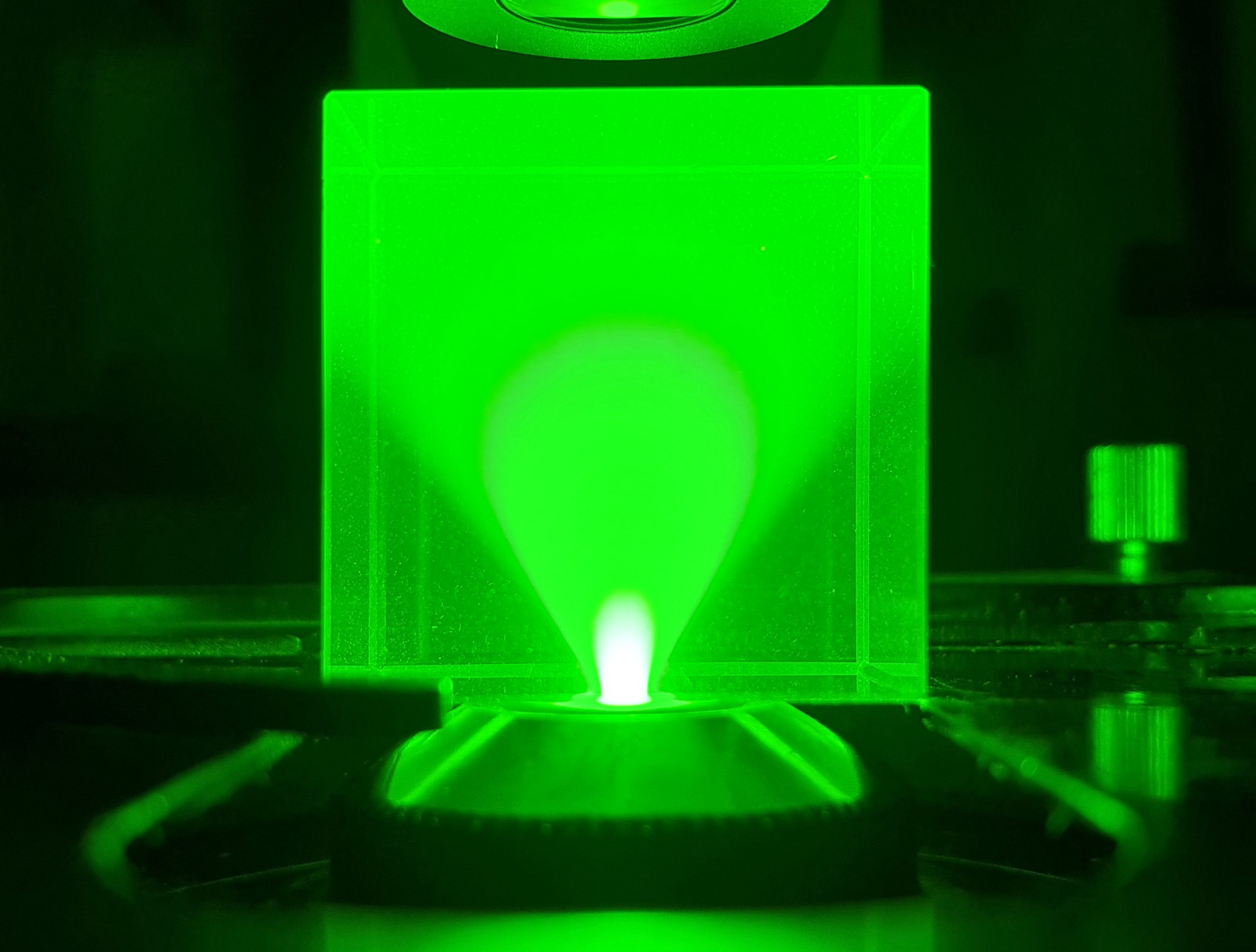
The condenser is at the bottom of the image, and the light (from a 365nm UV torch) is coming through and hitting the uranium glass cube. The glass fluoresces where the UV hits it. The condenser is producing a nice light cone, with just under a 90 degree spread which is what would be expected in this setup.
Next we have the UV fused silica condenser I made.
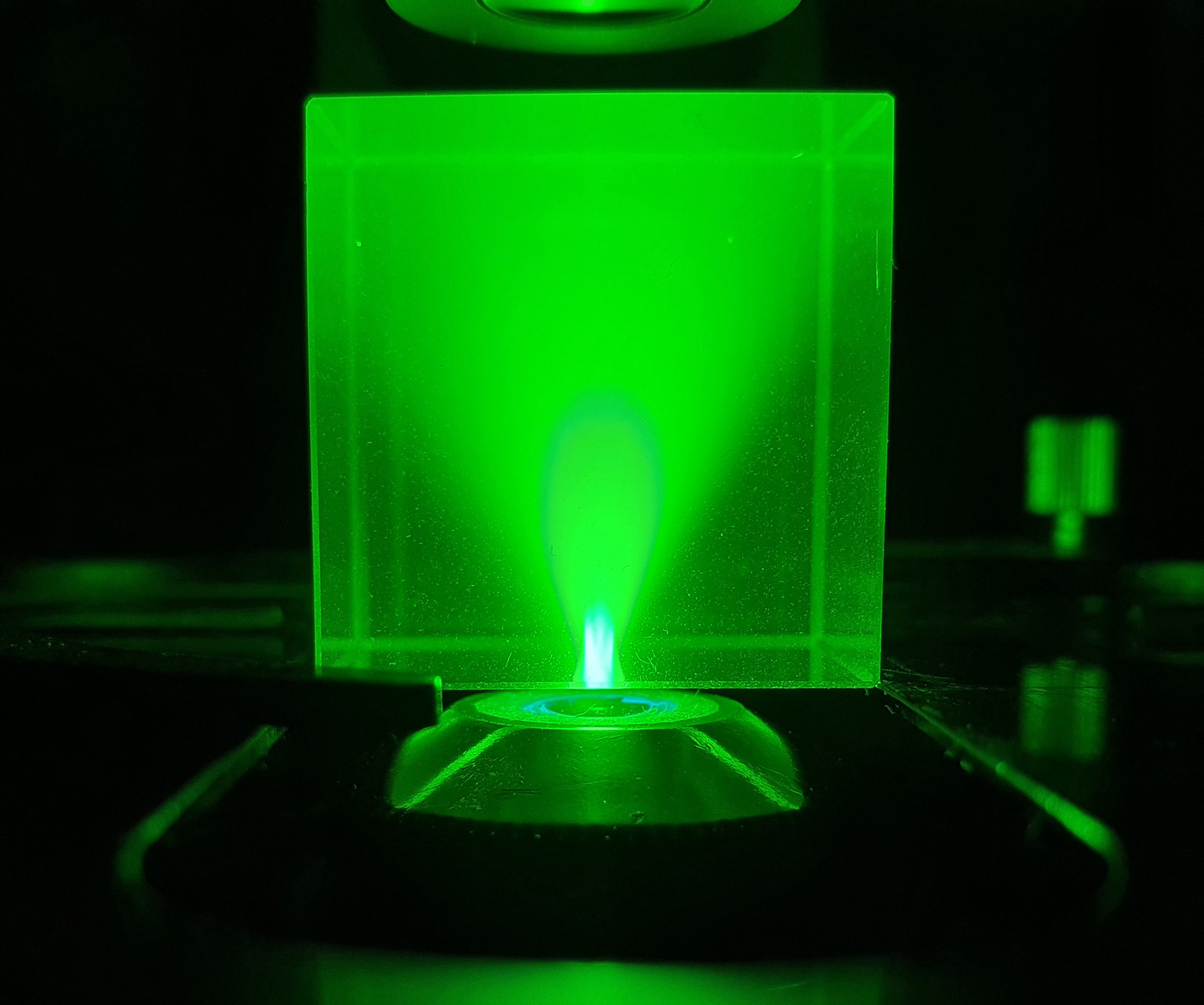
With my home made condenser, the edge of the cone is a bit less well defined than the one by Olympus, and I think the angle is slightly narrower. I am not hugely shocked that it doesn’t match the behavior of the commercially made one. Also, I had to move the condenser down slightly so the top of it was about 2mm below the glass cube, in order to get the brightest spot at the base of the cube. Again, this makes sense – I used a half ball lens as the top lens of the condenser, while the original was more of a ‘three quarter’ ball. As such mine would be expected to focus higher above the flat part of the lens. Unfortunately getting custom ball lenses ground would not be cost effective for me to consider. For what it is though, and for what it cost me, I am more than happy with its performance.
As a final thing, I want to show what happens to the light cone as the condenser iris is closed down (this was the commercially Olympus Abbe condenser).
Closing down the iris reduces the angle of the light cone, as expected, but it is nice to see this being demonstrated in practice.
Thanks for reading, and if you’d like to know more about my work, I can be reached here.