
Today’s post is a look at something I had not considered before acquiring a new microscope objective – a Zeiss Plan Neofluar 63x, NA 1.2, water immersion, coverslip thickness correction adjustment. This objective has an adjustment collar for coverslip thickness, and can be varied from 0.12 to 0.22mm (shown on the objective as ‘Korr’). It becomes very important to be able to compensate for coverslip thickness with high magnification, high NA objectives, especially with water immersion, in order to obtain the best images. This is a quick look at some images from this objective, where I have changed the setting of this collar, along with an assessment of the effects of altering the collar.
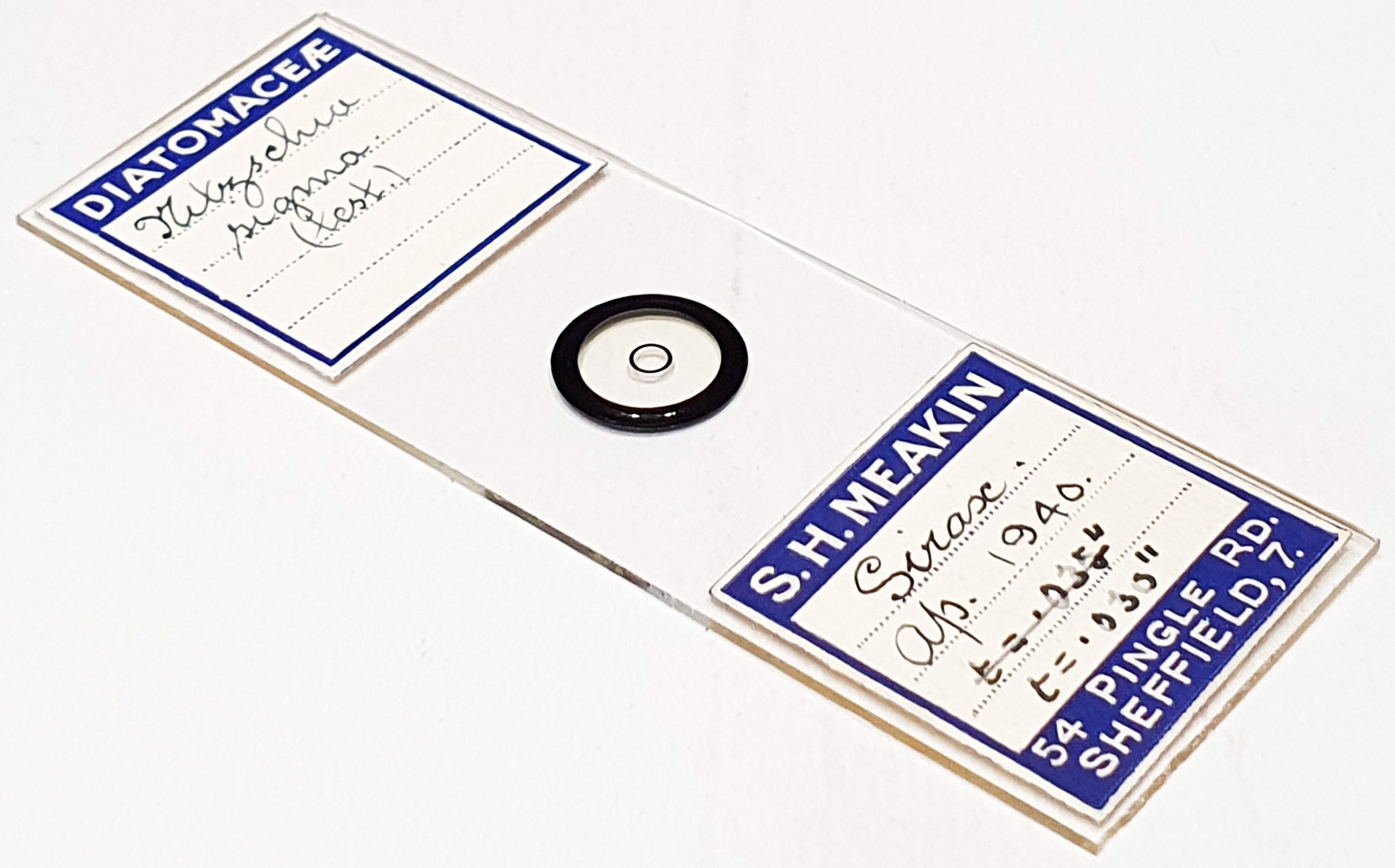
First the slide. It is a test slide of the diatom Nitzschia sigma, mounted in Sirax (a high refractive index mountant), and prepared by Samuel Henry Meakin in April 1940. The image below is a single frame (slightly cropped from the full frame, but not by much) using a 63x Zeiss Plan Neofluar NA 1.2 water immersion objective on my Olympus BHB microscope using 450nm oblique lighting.
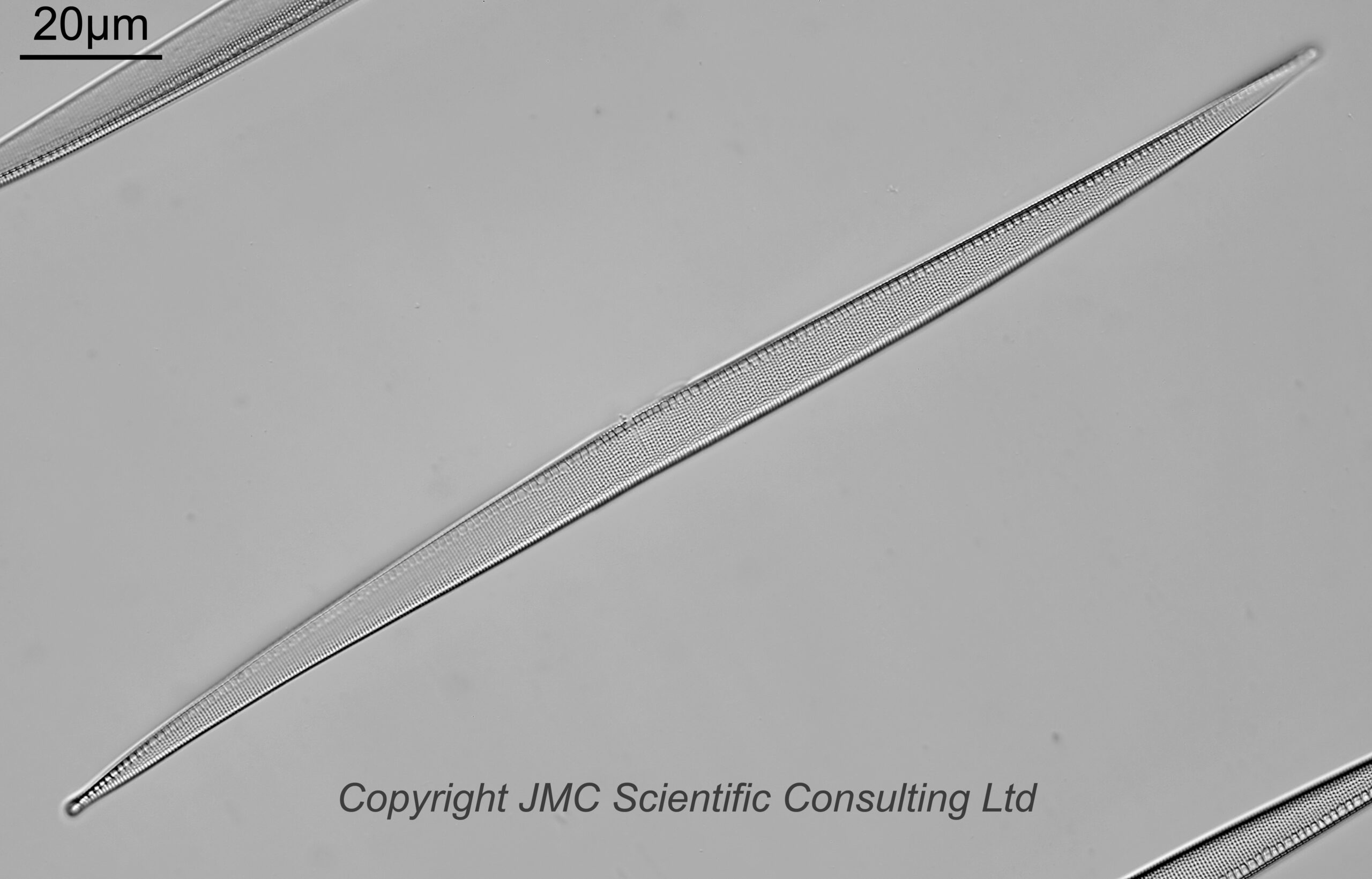
The diatom is fairly flat and level, so a single image shows quite a lot of it in focus. Next, the objective.
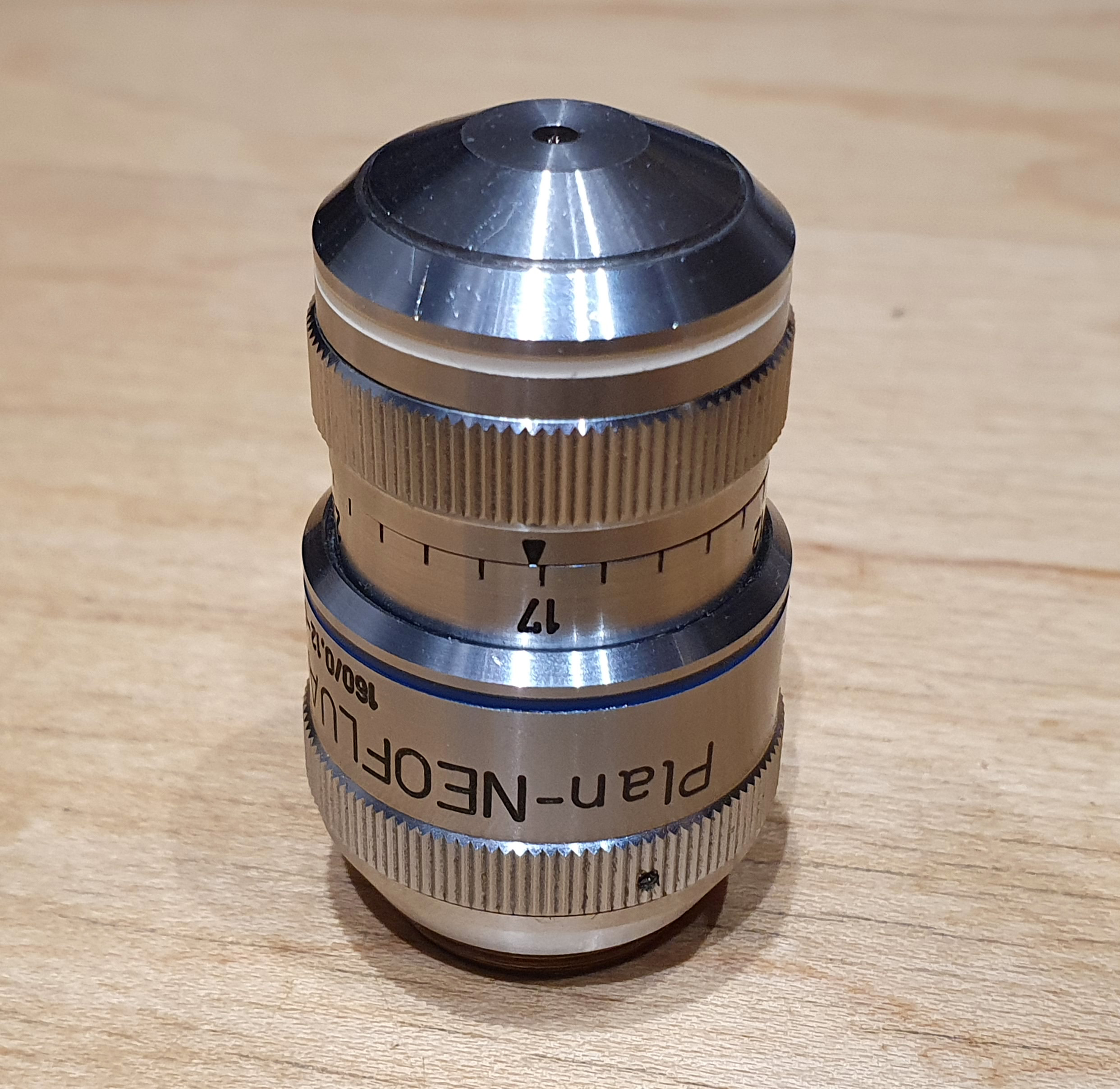
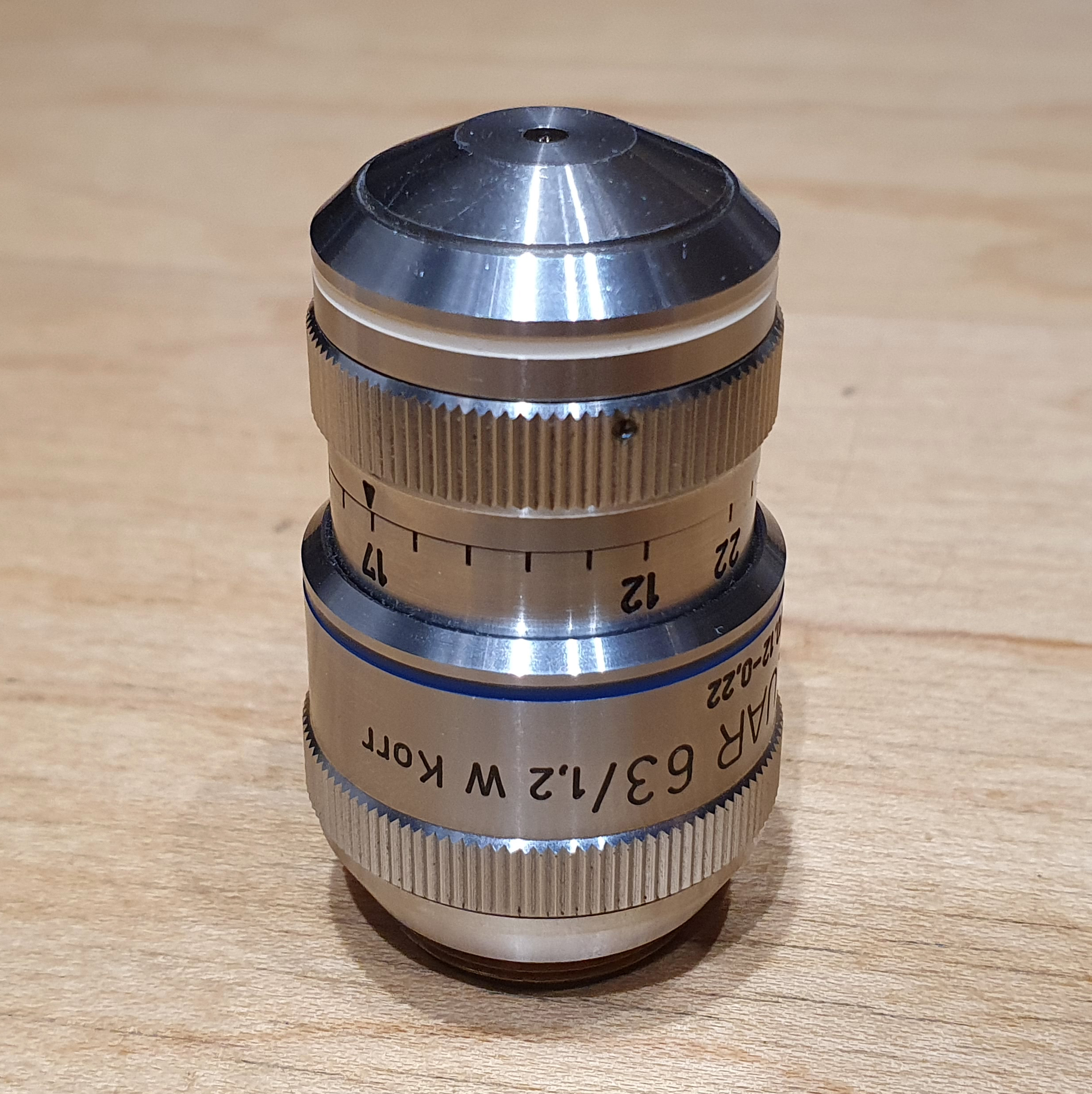
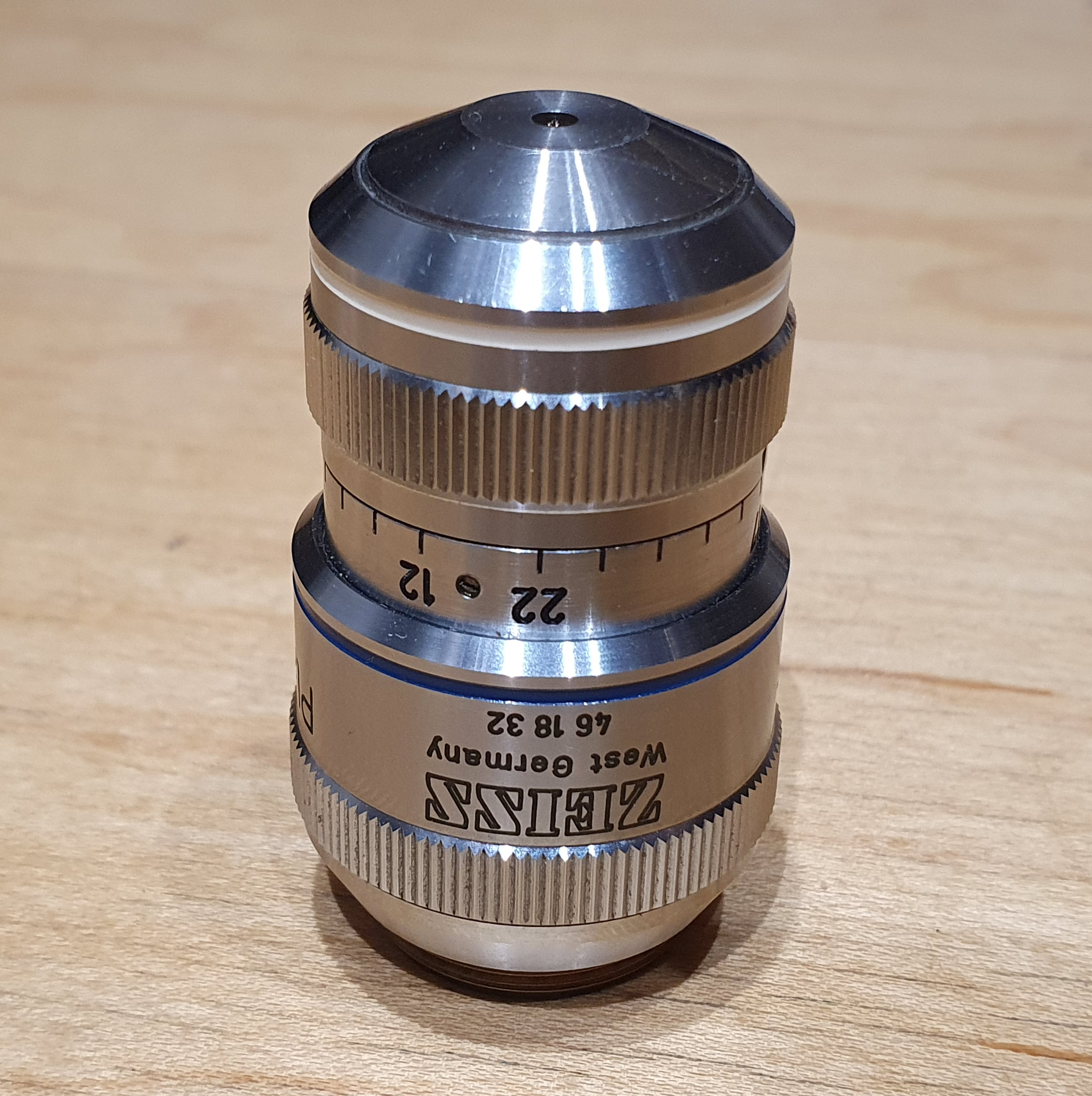
The objective has a collar on it which is labelled from 12 to 22, and this is for adjusting for coverslip thickness between 0.12mm and 0.22mm. Normally coverslips are 0.17mm, however there is some variability from one to another, and sometimes thinner or thicker ones are used. Giving the user the ability to adjust for coverslip thickness allows the objective to be optimized for a given slide so the best images can be captured.
For the above slide, when I changed the setting of the collar to thicker than 0.17mm, the image quality decreased – contrast got worse. However when I decreased it to 0.15mm the contrast improved, and it then got worse again below 0.15mm. This can be seen in the image below which shows a crop from two frames, one taken at a setting for 0.17mm and the other at 0.15mm.
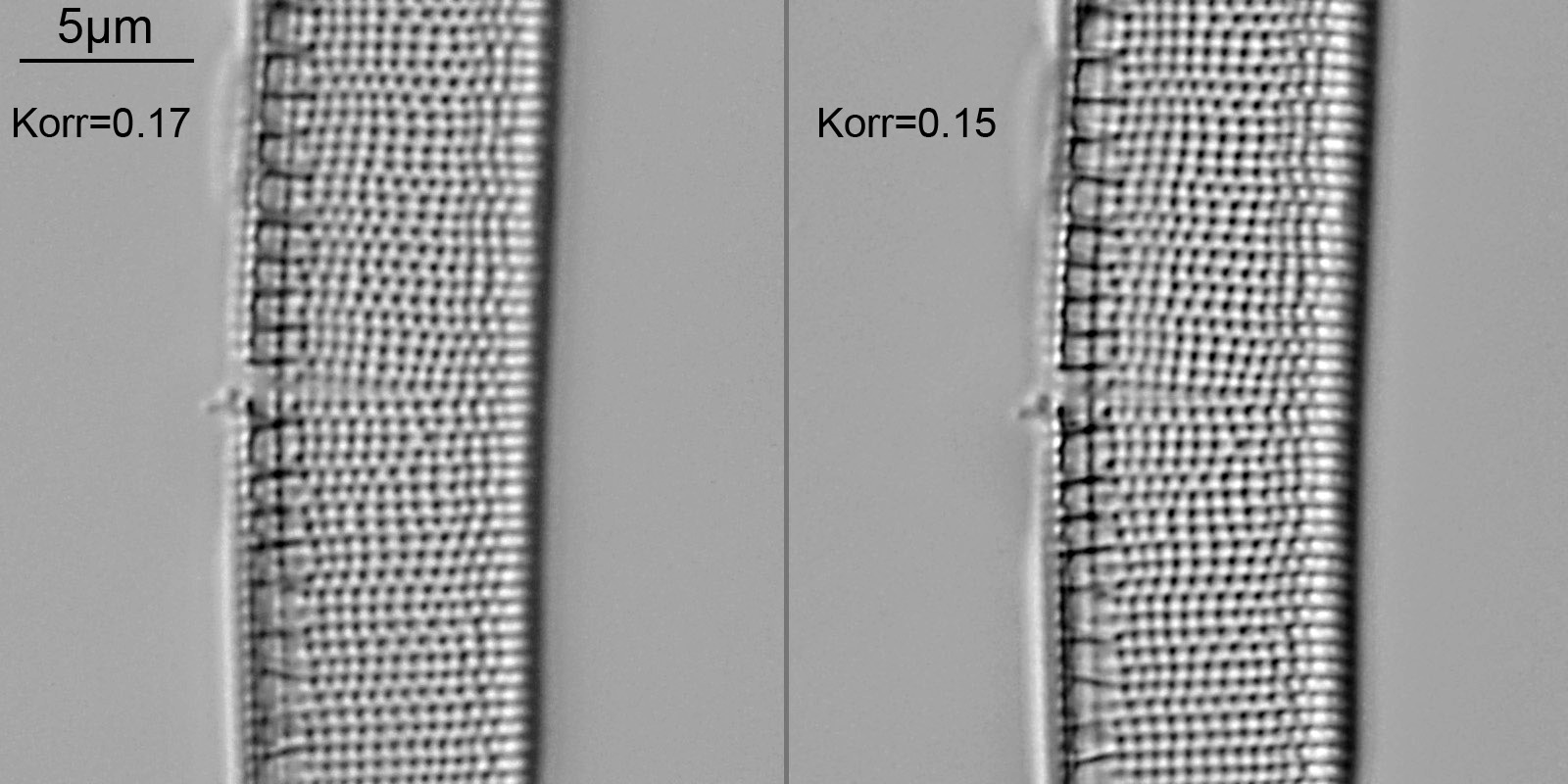
Although subtle, the image taken with the collar set to 0.15mm is slightly higher contrast than the one at 0.17mm. Both images were treated in the same way.
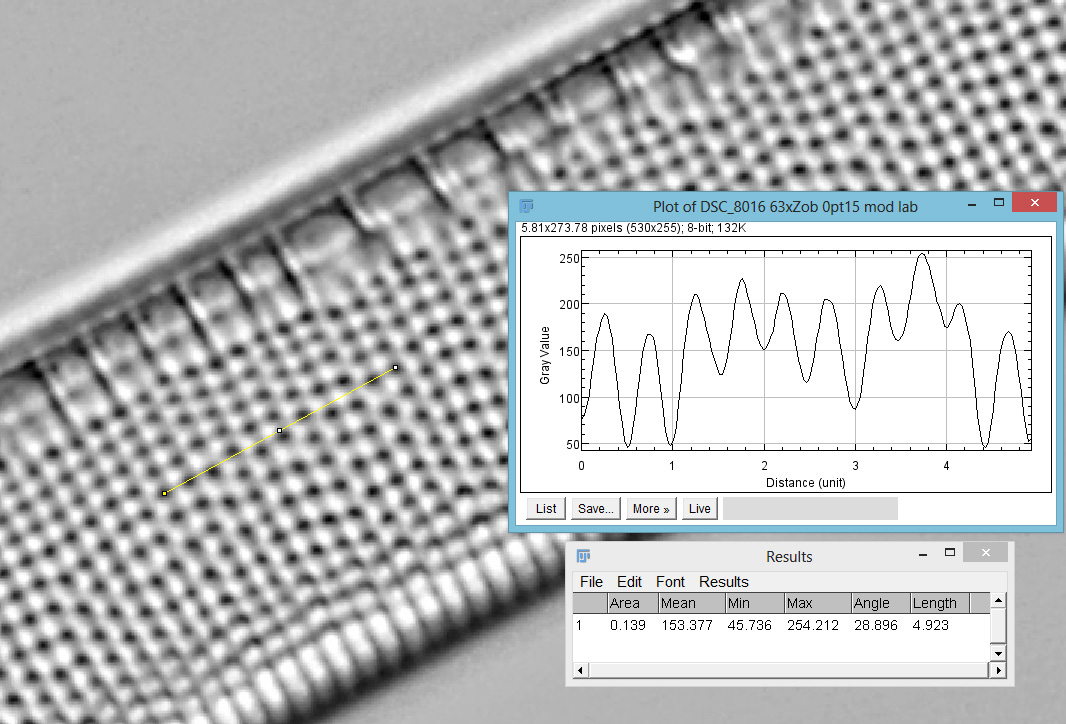
The image below shows a screen grab from ImageJ where I used it to measure the striae spacing (492nm).
With this objective having the ability to adjust for coverslip thickness, it got me wondering as to whether varying this collar changed the field of view of the image and if so by how much? If this varies significantly it would have a big impact on the size of any scale bar I apply to the image. Do I need a different scale bar for every setting?
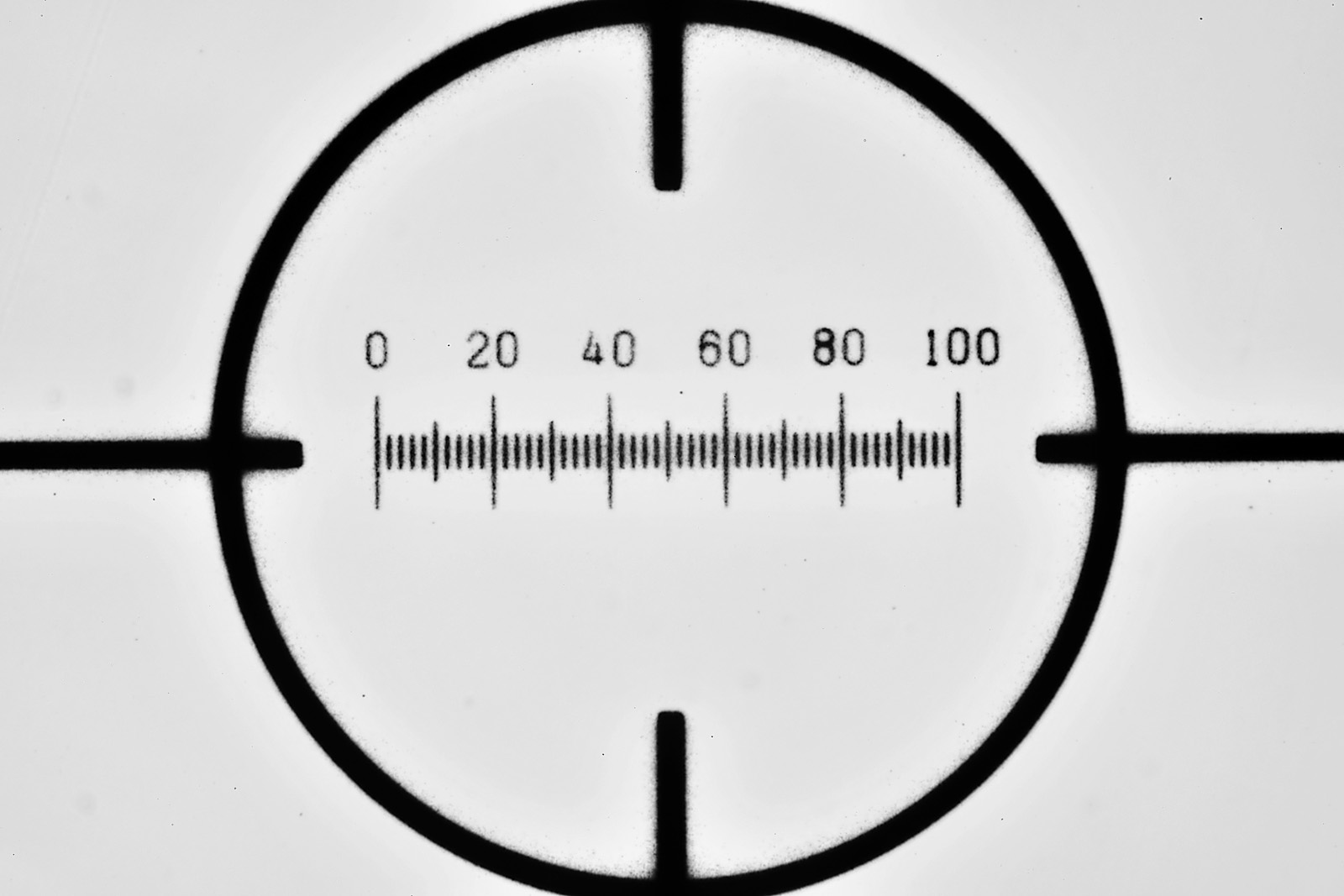
To look at this I did a set of measurements using a Graticules Ltd (now Graticules Optisc Ltd) 100 micron slide. The experiment was a ‘look see’ setting the collar to different positions, and then imaging the slide each time after refocusing. The images were then put into Photoshop and the number of pixels for the 100 micron scale bar measured.
First an image of the 100 micron scale, reduced in resolution for sharing here.
Now the results of the measurements.
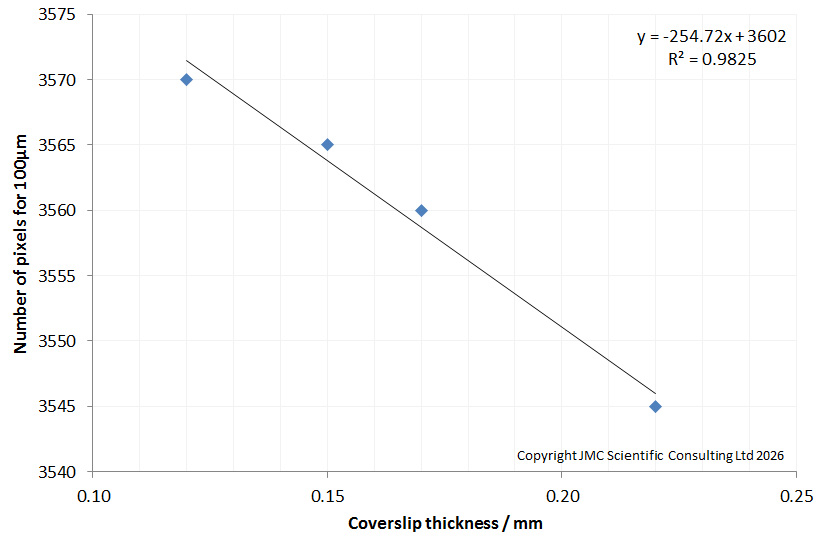
There was a change in the size of the 100 micron scale bar for the different settings. It varied from 3570 pixels when set to 0.12mm, to 3545 pixels for the 0.22mm setting. While there is an obvious trend, the change is small, basically less than 1% from one end of the adjustment range to the other. The difference between 0.17mm and 0.15mm was 5 pixels, which was about the limit of how well I could judge it in Photoshop, so I would say is down in the noise. This equates to just over 0.1% over 3500 pixels, so I can be fairly safe in using the same scale bar for my images when the coverslip thickness is 0.15mm or 0.17mm. Does adjusting the collar impact the field of view? Yes. Is it significant? Not enough to make me worry for the imaging I am doing with it, however if set to the extreme ends of the range I would probably correct for it.
Before finishing up though, I will point out some compromises with this experiment. I did not use a coverslip on the stage graticule. I just used water immersion direct on to the slide, and then adjusted to collar to different settings. The images, and measurements were done in Photoshop not ImageJ. I would say 5 pixels was about the limit of what I could judge in Photoshop, but there is a clear trend from one end of the scale to the other, rather than a random scatter, so I can confident in my measurements. Also the microscope is my modified Olympus BHB using a Nikon 2.5x CF PL photoeyepiece. This is a mismatched system. Would I see different results on a Zeiss microscope which this objective was designed for? Maybe. However I can only test on what I have, and I consider this a worst case stress test.
I did this work as searching online for an answer to the question ‘will changing the coverslip correction collar on an objective impact the field of view’ didn’t give me any definitive answers, which I was a bit surprised at. Sometimes, experiments are the only answer…..
As always, thanks for reading, and if you’d like to know more about my work I can be reached here.